Aucun message portant le libellé Microsoft. Afficher tous les messages

2010-12-25

Facebook’s voraussichtbarer Abfall


Wer würde heute wagen, die Wichtigket der sozialen Medien zu verneinen ? Sie erscheinen unvermeidlich, und nähren sich unaufhörlich von der viralen Kontamination. Wir rennen fleissig zwischen Myspace, Youtube, Facebook, Classmates, Twitter (bald 200 Milionen Benutzer), usw., ängstlich überall anwesend zu sein. Linkedin Begründer Reid Hoffman (70 Milionen Eingeschriebene) könnte behaupten, dass „Myspace ist der Bar, Facebook das Barbecue im Garten, Linkedin das Büro“. Und diese sozialen Medien vervielfachen sich: Flickr, Myheritage, Trombi, Last.fm, Plexo in den Vereinigten-Staaten, Viadeo in Frankreich, Xing im Deutschland, Jobssip im Spanien, Renren Xiaonei in China (eine Nachahmung von Facebook, deren Tittel bedeutet: die Leute auf dem Campus), und sogar im Afrika mit dem cellular Telefon : iYam.mobi, von Fritz Ekwoge entwickelt.
Facebook selbst, nur seit sechs Jahre gegründet, scheint eine Million Benutzer mehr jede drei Monate zu zählen, wenn wir die ausserordentlichen unprüfenbaren Zahlen glauben, die angekündigt sind, und die beim Ende 2010 sech Milionen erreichen werden. Im Kanada hätte sich ein Bewohner aus zwei eingeschrieben, und sie sind so viele, dass man von einem „Facebook Volk“ spricht! 2009 waren Facebook’s Einkommen 635 Millionen, und sie sollten beim Ende 2010 die Milliarde treffen. Nach dem amerikanischen Institut Hitwise zählt Facebook 3% mehr einzige Benutzer als Google, und auch mehr besichtigte Seiten, während die mehrmahl verschiebene Ankündigung von „Google me“ nochmahl verspätet wird. Facebook erregt, sagt mann, 25% der Internet Kommunikationen in den Vereinigten-Staaten.
Sollte man annehmen, dass die Durst nach Sozialization nicht vermindern wird, und auch nicht das Gefühl der Einsamkeit in unseren individualisten Massen, dann kommt die Frage: wie kann man heutzutage den voraussichtbaren Fall von Facebook vorgreifen ? Es git dafür mehrere Gründe.
Vom Anfang an war Facebook ein sozialer Netz für Jüngere, die Freunde suchen. Es ist seitem eine Mitbewerbung gekommen, immer mehrere Bekanntschaften anzuschlagen. Es sieht aus, wie bei allen diesen Eingenommenheiten der jüngeren Generationen, die sich mit aufeinanderfolgenden Moden identifizierten, sei es für Kleidung, Musik oder Tanzen, dass die Facebook Generation ältern wird, und die nächste mit was anderem sich diferenzieren wollen wird. Schon hört man neue Jüngeren angeben, dass Facebook langweilig und altmodisch sei. Ähnliches geschieht mit den Moden für digitale Programmen, Geräten und Gadgets. Die digitalen Taschenuhren, die legitimer Weise in den Kaufladen eingefallen waren, sind heute nicht mehr zu finden. Die Mode ist jetzt zur grossen analogischen Zeigern und Zifferblatten zurückgekomen, obwohl diese Uhren nur eine sehr begrenzte Information im Vergleich mit den digitalen anbieten. Man spricht nicht mehr von „Second Life“, ein elektronisches Spiel in virtualer Umwelt, die einen Welterfolg drei Jahre her gekannt hat. Jeder beschäftigte sich zur Zeit ein Avater zu programmieren und animieren, Grundspekulation mit dem in Dollaren wechselbaren Geld zu machen. Alle wichtigen Verkaufgesellschaften, Institutionen und sogar manche Universitäten hatten in diesem aufregenden virtualen Raum für Gebäude und Schaufestern investiert.
Trotz der heutigen Neigung für Durchsichtigkeit und Echtheit erregen die sozialen Medien mehr und mehr Misstrauen. Es ist klar, dass diese naïven Facebook Benutzer, die ihr privates Leben täglich on line vorzeigen, Datastosse über sich selbts anhäufen, die sofort für das Beste wie auch das Schlimmste gebrauchbar werden. Eine neulich übers Benehmen der Konsumenten von Ilgo in Frankreich veröffentliche Untersuchung, zeigt dass 80% der Internet Benutzer die Konfidentialität’s Versprechen und Beachtungen der sozialen Medien nicht trauen. Und manche öffentliche Streite gegen Facebook, den wichtigsten, haben schon seine Leitung gezwungen zurückzuweichen, und scheinbare Zugeständnisse anzunehmen. Trotzdem bleibt es schwierig aus Facebook herauszukommen, und dem einen, der es schafft, wird es sofort erwähnt, um ihn zu „beruhigen“, dass im Falle er später sein Gedanke änderen, und wieder in Facebook sich einscreiben möchte, er alle die privaten Daten unberührt wieder finden wird, die er gerade auszuwischen versucht hat, um sein privates Leben und seine Zukunft zu schützen! Diese zwei Facebook Gesichte, das eine voll frendlicher Lust, das andere hinterhältig möglicher kommerzialen Ausbeutung unserer persönlichen Daten, klingen als eine furchtbare Kontradiktion.
Tim Berners-Lee, der Erfinder des WWW gerade 25 Jahre her, hat neulich einen Artikel herausgegeben, um den „geschlossenen Karakter“ der Facebook Plattform heftig anzuzeigen. Dazu müssen wir auch unterstreichen, dass, trotz der neuen Ankundigung einer einfachener und schnellerer dem Chat änlicher Weise zu kommunikieren, die das alten elektronische email ersetzen würde, hätte man es schwierig, irgendeiner technologischen Innovation mit den Facebook‘s Funktionalitäten zu sprechen. Es ist wahr, dass Facebook es nicht braucht, da diese Platform keine Tiefe bietet, insoweit sie sich zu oberflächlichen Kommunikationen ohne Inhälte widmet. Es bleibt aber deswegen schwierig vorzusehen, wie diese Platform den offenbare Gegensatz zwischen den naïven Beziehungen der Jüngeren und den gesellschaftlichen und beruflichen Gebrauchen Erwachsenen, die sie für politischen, kommerzialen, humanitarien Aktivitäten, oder für literarischen, wissenschaftlichen, geschichtlichen, akademischen Diskussionnen benützen, überwinden könnte. Hier sehen wir wieder zwei Facebook Gesichte, die widersprechend sind. Die Kundschaften sind verschieden, die Tätigkeiten und technologischen Bedürfnisse auch. Es ist klar, dass diese Platform zu breit ist, nicht bald zerbrechlich zu werden.
Der kommerziale, immer drohende Missbrauch der persönlichen Daten, der schon mehrere Benutzer Facebook zu verlassen treibt, hat New Yorker Studenten angeregt die alternative Plattform Diaspora im vorigen Mai 2010 zu entwickeln. Sie haben sich für open source Software entschlossen, um die Möglichkeit den Benutzern zu geben, die Platform zusammen und weiterzuentwickeln und seine Orientationen, Gebrauchen und Regelungen selbst zu kontrolieren.
Die sozialen Medien werden sicher nicht verschwinden, aber sir werden sich weiter teilen, um besser mehr besondere Bedürfnisse mehr spezifiken Gemeinschaften zubeantworten. Im Weltstreit zwischen Microsoft, Google und Apple, Facebook ist sicher, trotz seinem heutigen übermässigen Erfolg, oder sogar wegen dieser oberflächligen strukturlosen Eingenommenheit das empfindlichste und verwundbarste dieser digitalen Reichen. Die Kommunikationen ohne Inhalt fliessen von einer Vase zur nächsten wie Wasser, ohne sich zu fixieren. Andere Metaphor: die viralen Kommunikationen bewegen sich sehr genau in zahlreichen Blocken, aber sie ändern auch plötzlich ihre Richtung zusammen im Block wie Fischen- oder Papageigruppen. Facebook’s Zukunft ist mehr als unbestimmt. Von seinem Erfolg gelitten und gefangen, wird es nicht fähig sein, sich neu zu denken, und seine sozialen Funktionen und Funktionalitäten besser zu definieren und zielen. Wie könnte es gelingen, bevor die Eingenommenheit der nächsten Generation zu verlieren, wie auch die Treue des beruflichen Benutzer, die ihm heute angehackt sind.
Hervé Fischer

2010-12-12

Anticipating Facebook's decline


Who would today deny the importance of social media ? They look essential to our digital communications and they are continuously nourished by an increasing viral contamination. We are running from Myspace to Youtube, Facebook, Classmates, Twitter (soon reaching 200 million users), etc. We feel we have to be active everywhere in the social media sphere. Reid Hoffman, the founder of LinkedIn (70 million users), suggested that "Myspace is the bar, Facebook is the barbecue in the garden and LinkedIn is the office"! And these social media have quickly multiplied: Flickr, Myheritage, Trombi, Last.fm, Plexo in the US, Viadeo in France, Xing in Germany, Jobssip in Spain, Renren Xiaonei in China (an imitation of Facebook, those Chinese name means “the people on the campus”), and even in Africa, on mobile phone, with iYam.mobi, launched by Frotz Ekwoge.
Facebook, after only six years of existence, seems to increase now the affluence of its users by 100 million each three months, according to the phenomenal numbers which are announced. One Canadian out of two would be enrolled, with such fervor that one may speak of "Canada as a Facebook nation". With 635 million revenues in 2009, Facebook may reach the billion dollars in 2010. According to the American Institute Hitwise, Facebook attracts 3% unique visitors more than Google with more pages visited. In the same time the launching of Google me has been again postponed. A creditable estimation figures that Facebook captures today 25% of the internet traffic in the US.

Taking in account that the social desire for being connected, resulting from a prevalent feeling of loneliness in our individualistic social masses, will not diminish, it may look unreasonable to anticipate today the inevitable decline of Facebook. Still, the reasons are many.
Facebook was launched as a platform for adolescents looking for friends. And it remains a daily competition for many of them to increase the number of their friends, not necessarily giving attention to the quality of these relations. As it always happened of such infatuations of younger generations in the past identifying themselves with successive and opposite clothing modes, new dances and musical groups, the Facebook generation will pass and be replaced by the next one. We already hear of Facebook as has been and annoying by younger adolescents. We indubitably observe the same ephemeral trends in the succession of digital tools, gadgets and programs. Digital watches, which have known a legitimate invasive success in the recent past, have almost disappeared of the market today. The mode has turned in favor of big hands on large faces. We almost don’t mention anymore Second Life, a videogame which has encountered a huge success three years ago, and attracted everyone, eager to design his own avatar and let it leave in this virtual space, enjoying a convertible money, real estate speculation, cultural activities, shops and show windows from big trademarks and institutions.
In spite of today’s fervor for transparency and authenticity, friends’ networks such as Facebook give rise to more and more distrust. Of course many ingenious young Facebook users still put themselves their private data files on line, which may be later exploited for the best and the worst. But a recent survey published by Illigo, a French agency of consumers’ behaviors analysis, concluded that 80% of internet users distrust the privacy policies of the social media in general. Facebook itself, the most successful, has been confronted to a series of hard polemics, which have obliged its managers to move back several times and make so called concessions. Nevertheless it remains difficult to get out of Facebook and if you succeed, the site will make you relax, mentioning that in case you would like to come back, you will find your page again with your personal data, the same which you have tried to definitively delete to protect your privacy and life to come! These two faces of Facebook, the friendly one, and the other one with sly data mining are terribly contradictory.
Tim Berners-Lee, the inventor of the web - twenty-five years ago last November -, has just published an important article to criticize Facebook for being a close platform. Allow us to also underline, in spite of the recent announcement launched by Facebook concerning a new application for interpersonal exchanges aimed to replace the so called obsolete email by a faster and easier way, that Facebook has not yet develop any technological innovation deserving to be mentioned. Moreover, it lacks profundity and content’s quality, dedicating itself to superficial personal exchanges without much to say. l don’t see how this platform will be able to overcome much longer the evident contradiction between naïve exchanges between younger and serious uses of professionals and corporations, such as political, commercial, or humanitarian campaigns, literary, scientific, historical or academic debates, etc. Again we are confronted to two faces of Facebook which are not consistent. Facebook customers are divergent, their activities too and this platform looks evidently to wide not to appear fragile and irrelevant.
Not to mention that the commercial abuse of private profiles and data, which looks inevitable, prompts many users to quit Facebook, and has given rise to an alternative initiative called Diaspora (New York, May 2010), aimed to develop an open source platform allowing all users to control its orientations, policies and uses.

Social media will for sure not disappear, but they will certainly segment more, aiming to better answering to specific communities’ needs. Confronted to the hard competition between such digital empires as Microsoft, Google or Apple, Facebook looks evidently as the most vulnerable of them, not only in spite of its fast and spectacular rise, but because of the excess of it, which results from a superficial and unstructured infatuation. Communications without content are alike water, running from a vase to another. Allow us to use another metaphor: viral contaminations are alike schools of fishes or parrots; they move quickly as blocks without warning. The future of Facebook is more than uncertain. Captive in its excessive success, it would have severe difficulties to redesign itself, and does not seem able to better aim at more specific objectives and functionalities before lousing the favors of the next generation of adolescents and the fidelity of corporative and institutional activities linked to it.
Hervé Fischer

2010-12-04

Le déclin prévisible de Facebook


Qui oserait nier aujourd'hui l'importance des médias sociaux. Ils nous apparaissent comme des incontournables, que la contamination virale nourrit sans cesse. Nous courons entre Myspace, Youtube, Facebook, Classmates, Twitter (bientôt 200 millions de comptes), etc. anxieux d'être présents partout. Le fondateur de Linkedln (70 millions d'usagers), Reid Hoffman, a pu affirmer que "Myspace c'est le bar, Facebook c'est le barbecue au fond du jardin, et Linkeldln c'est le bureau". Et ces médias sociaux se sont multipliés: Flickr, Myheritage, Trombi, Last.fm, Plexo aux États-Unis, Viadeo en France, Xing en Allemagne, Jobssip en Espagne, Renren Xiaonei en Chine (une imitation de Facebook qui se traduit ainsi: les gens sur le campus), et même en Afrique, sur téléphone mobile: iYam.mobi, lancé par Fritz Ekwoge.
Facebook lui-même, qui a juste six ans d'existence, semble augmenter son nombre d'usagers d'un million par trimestre, à en croire les chiffres faramineux et non vérifiables qui sont annoncés, atteignant les six-cent millions en cette fin de 2010. Un Canadien sur deux s'y serait inscrit, au point où l'on parle du Canada "as a Facebook Nation". Et ses revenus, de près de 635 millions en 2009 devraient atteindre le milliard pour 2010.Selon l'Institut américain Hitwise, Facebook pourrait se prévaloir de 3% de visiteurs uniques de plus que Google et de plus de pages vues. Simultanément l'annonce du réseau "Google me" est encore une fois reportée. Facebook constituerait, dit-on, 25% du trafic de l'internet aux États-Unis.
Alors que le désir de socialiser ne risque pas de diminuer, ni le sentiment de solitude de nos masses individualistes, comment peut-on annoncer aujourd'hui le déclin prévisible de Facebook? Il y a bien des raisons.
Facebook est d'abord un réseau d'adolescents en quête d'amis - c'est devenu une sorte de compétition d'en afficher toujours plus -, et comme tous les engouements auxquels s'identifient successivement les générations de jeunes, avec des modes vestimentaires, des groupes musicaux ou des danses, la génération Facebook va vieillir et passer la main. On entend déjà de plus jeunes déclarer que "Facebook c'est plate!". Nous observons la même éphémérité dans la succession des modes pour les outils numériques. Ainsi, les montres digitales, qui avaient envahi à juste titre le marché, en sont quasiment disparues aujourd'hui. La mode est revenue aux grandes aiguilles sur de larges cadrans. On ne parle quasiment plus du jeu Second Life, qui avait tant de succès il y a trois ans, avec sa spéculation foncière, et qui battait sa propre monnaie, convertible en dollars. Chacun voulait y créer son avatar, tandis que les grandes institutions et les multinationales y investissaient pour ouvrir des vitrines et des commerces. Malgré le goût actuel pour la transparence et l'authenticité, les réseaux d'amis tels que Facebook provoquent de plus en plus de méfiance. Il est vrai qu'en exhibant ainsi leur vie privée, beaucoup de jeunes se fichent ingénument eux-mêmes, et que ces données personnelles sont aussitôt utilisables pour le meilleur et pour le pire. Une enquête récente menée par Iligo, une agence française d'analyse des comportements des consommateurs, révèle que 80% des internautes n'ont pas confiance dans la politique de confidentialité des médias sociaux qu'ils utilisent. Dans le cas de Facebook, le plus en vue, de nombreuses polémiques ont obligé ses dirigeants à reculer et à faire d'apparentes concessions. Il n'en demeure pas moins qu'il est compliqué d'en sortir et que si vous y parvenez, le site vous "rassure" en vous indiquant que si vous changez d'avis et voulez plus tard vous réinscrire, vous y retrouverez aussitôt toutes les données personnelles que vous y avez mises - celles que précisément vous venez d'essayer d'effacer définitivement pour protéger votre vie privée et votre avenir! Ces deux faces de Facebook, l'une de gentille convivialité, l'autre d'exploitation commerciale sournoise de ces données privées, sont terriblement contradictoires.
Tim Berners-Lee, l'inventeur du Web, voici juste vingt-cinq ans, vient de publier une mise en garde insistante sur le "caractère fermé" de la plateforme Facebook. Nous ajouterons que malgré l'annonce récente de Facebook d'offrir désormais un mode d'échange facile, rapide et convivial qui allait rendre obsolète le "vieux courriel", ce réseau n'offre guère d'innovations dans ses fonctionnalités. En outre, il manque de profondeur, se dédiant à des échanges superficiels et sans contenus. Je vois mal, enfin, comment cette plateforme surmontera encore longtemps la contradiction évidente entre les relations naïves d'adolescents et les usages adultes corporatifs ou professionnels, tels que les campagnes politiques, commerciales, humanitaires, les débats littéraires, scientifiques, historiques, universitaires, etc. Voilà encore deux faces de Facebook qui ne s'accordent pas. Les clientèles ne sont pas les mêmes, les activités non plus et cette plateforme est manifestement trop large pour ne pas apparaître bientôt fragile et non pertinente.
En outre, l'abus commercial constamment menaçant de l'exploitation des données personnelles, qui incite beaucoup d'utilisateurs à quitter Facebook, a suscité une initiative alternative, celle de Diaspora à New York, en mai 2010, qui propose une plateforme en logiciel libre avec code source ouvert, qui permet à tous les usagers de contrôler les orientations, les politiques et les usages du site.
Les médias sociaux ne disparaîtront certainement pas, mais ils vont se segmenter davantage, pour mieux répondre à des besoins plus spécifiques de groupes plus définis. Et dans la lutte entre les empires numériques Microsoft, Google et Facebook, c'est ce dernier qui est manifestement le plus fragile, malgré l'excès de ses succès actuels, ou plutôt à cause de cet engouement superficiel et non structuré. Les communications sans contenu sont comme l'eau, qui se répand successivement en vases communicants. Autre métaphore: les contaminations virales sont comme les bancs de poissons ou les volées de perroquets: elles se déplacent rapidement et en bloc. L'avenir prochain de Facebook est plus qu'incertain. Entraîné par son succès, on ne voit pas comment il pourrait se reconfigurer en ciblant mieux ses objectifs et ses fonctionnalités avant de perdre les faveurs de la prochaine vague d'adolescents et des usagers adultes qui s'y sont accrochés.
Hervé Fischer

2008-05-12

Facebook’s two Faces

Facebook has become an incredible success in Western countries, daily commented in the media. This platform of socialization is reaching now some 60 millions members in the world. Just in Canada 8 millions people have registered, which means one out of four Canadian citizens uses it. This digital innovation seems to answer an incredibly urgent social need. And this new phenomena tends now to extend even to China. A similar socialization site Xianoei, the so called Chinese Facebook, has raised $430 millions recently in funding from Softbank, according to a report from Venture Beat*. Facebook has also eventually tried to acquire another similar website in China, called Zhanzuo.com, which counts 7 millions users**.

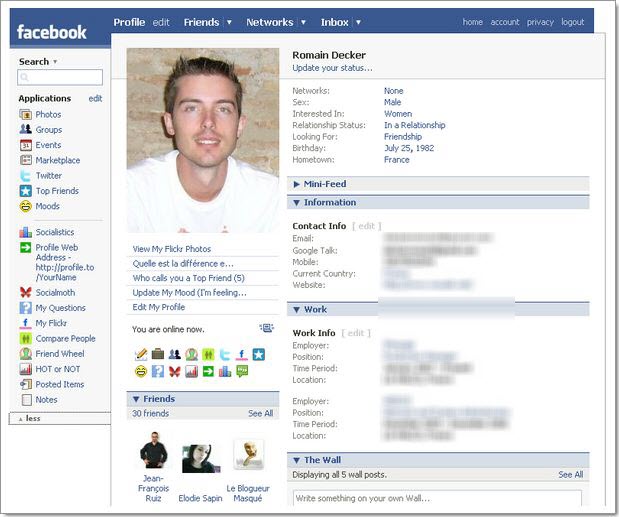
The original idea inspiring these popular networking sites originated from the school’s albums of names and photos of the students of each class traditionally published yearly by English and American colleges and universities. But it has become much more powerful, when launched on line. Any user is invited to freely put his photo and name on the site, with his email address and to add personal information, such as his individual interests, the books he reads, the films he likes, his favourite sportive activities, and to include photos of his house, his family, his boyfriend, his pets, his holidays, etc. And of course, you should not forget to publish and update your curriculum vitae, supposed to attract also possible future employers. As such, Facebook looks mainly as a public virtual meeting place where you may be seen and contact friends. It gives also to many users a feeling of a higher level of existence and social recognition. Shortly said, it is a cyber public place for networking, public relations, social valorization and the hope of making friends. Not to be there looks like staying in the obscure shadow of today’s life, or paradoxically not really existing!

We cannot avoid questioning such behaviours and their incredible digital success from the psychological and sociological point of view. Should we conclude that so many people suffer of solitude in our mass societies? Is real communication getting so poor and rare now a days, that people need an artificial digital device to compensate their frustrations and anonymity? When people watch their page in Facebook and hope daily if not hourly for a click on their name, doest it mean that the traditional public places, squares, cafés, bars, discotheques, sport places, clubs, etc. have lost their efficiency and conviviality? We observe even a surprising addiction of young people, eager to visit constantly their Facebook pages and look for eventual visits. And this site is not any more just a place for students and younger. It becomes a kind of recognized social institution. Any singer, sportsman, political candidate, has to be there and to react to visitors, update, multiply his information, and seduce. Even humanitarian organizations, libraries, churches, big corporations think they have to register and promote themselves on Facebook. Will it become a place for a philosopher? For future Socrates to teach?

Of course, we cannot only consider this angel’s face of Facebook in its lashing financial success. Launched 2004 by Mark Zuckerberg, a student at Harvard University, this site reached already a turnover of 50 millions dollars in 2006, and may be worth now 15 billions dollars. Microsoft has bought a minority participation of 240 millions$ last October. Facebook has become the sixth most visited website worldwide with a frequentation far larger than in any other similar popular exchange website, such as well known MySpace, Yahoo, OpenSocial, Friendster, Windows Live Space, Youtube, etc.

Attracted by the huge amount of personal information collected spontaneously about so many people which has become now accessible on Facebook for anyone, many big corporations have considered using it for lifestyle analysis of possible clients, and for new marketing opportunities. They have seen the possibility of focussed promotion campaigns operating by personal emails. Coca-Cola, Microsoft, Sony, Blockbuster, Overstock and many others have become soon close and active partners with Facebook. And Mark Zuckerberg, listening of course to the siren song, has integrated in his site new automatic functionalities to facilitate this focused marketing. Maybe with a sense of self humour, he has given it the significant and trivial name of Bacon. By selling the personal profiles of its members to big corporations, Facebook could hope to generate high publicity incomes, and increase immediately its commercial value.

This evolution let appear in full light the other face of Facebook, which does not look anymore just as a friendly virtual networking place. Members discovered they ware trapped in a commercial disposal. Of course, many of them have protested and denied the right to be used that way, denouncing the commercial emails they were receiving. They have organized a protest, Moveon.org, and let circulate a petition requesting the respect of their privacy. The Electronic Privacy Information Centre has also publicly attacked the Beacon initiative, and all together they have obliged finally Facebook to move back. It has offered the possibility to those who want to remove their automatic agreement to the Bacon functionalities.

Just considering the Beacon story, one could say it was an abuse of power by Facebook, which has been corrected, and we should consider this misuse as an easy to understand commercial temptation for a young and ambitious entrepreneur, whom one had ingeniously considered as a gentle and stimulating social animator. But giving then more attention to the by-laws which are published in small letters on the website, one discovers surprising evidences of the obscure face of Facebook. By entering the website and giving one’s name and email address, one is considered automatically subscribing contractual obligations which are outrageous because they oppose directly to the fundamental civil rights. If you just take a chance of reading the contract (http//www.facebook.com/policy.php), – which nobody reads - you will discover the methods and spirit of Facebook, which declares:

- We may share your information with third parties, including responsible companies with which we have a relationship.

- We may use information about you that we collect from other sources, including but not limited to newspapers and Internet sources such as blogs, instant messaging services and other users of Facebook, to supplement your profile.

- By posting User Content to any part of the Site, you automatically grant (…) an irrevocable, perpetual, non-exclusive, transferable, fully paid, worldwide license (with the right to sublicense) and distribute such User Content for any purpose, commercial, advertising, or otherwise(…) (“Terms of use” de Facebook au 21/11/2007 www.facebook.com/terms/php).

- Facebook Beacon enables your brand or business to gain access to viral distribution within Facebook. Stories of a user’s engagement with your site may be displayed in his or her profile and in News Feed. These stories will act as a word-of-mouth promotion for your business and may be seen by friends who are also likely to be interested in your product.

Finally you have abandoned for ever your intellectual and moral property on any information you have put on Facebook. Facebook claims the right to use and exploit it the way it wants. You are not allowed to take it back from the site. And worse: Facebook states even the right to put additional information about you, taken from any other source it may consider, without asking your permission. Frankly such a contract is just outrageous. It is the worst example of the abuses of the Digital Far West, with no law, no sheriff, which the cyberspace may still evocate.

Hervé Fischer
__________________________________________

* Xinaoei was founded in December 2005 by Qinghua University graduates Wang Xing, Wang Huiwen, Lai Binqiang and Jacky, later on acquired by Oak Pacific Interactive in 2006 and announces now some 16 millions users. www.xiaonei.com

** Zhanzuo.com counts 7 millions registered users. It has been told that Facebook was ready to acquire it in November 2007 for $85 millions. It has not yet been confirmed.